strategy branches in Google guidance
Either prevent faceted URLs from being crawled when you do not need them indexed, or make crawlable facet URLs follow web-safe URL and response rules when they may be indexed.
Technical SEO · Faceted navigation · Crawl & indexation
Faceted navigation becomes an SEO problem when a useful product-filter UI quietly turns into an uncontrolled URL generator. The durable fix is not to choose one directive for every filter URL. Define a URL eligibility contract first, make discovery, crawl, indexing, canonical and sitemap behavior enforce it, then validate the same URL cohorts after release.
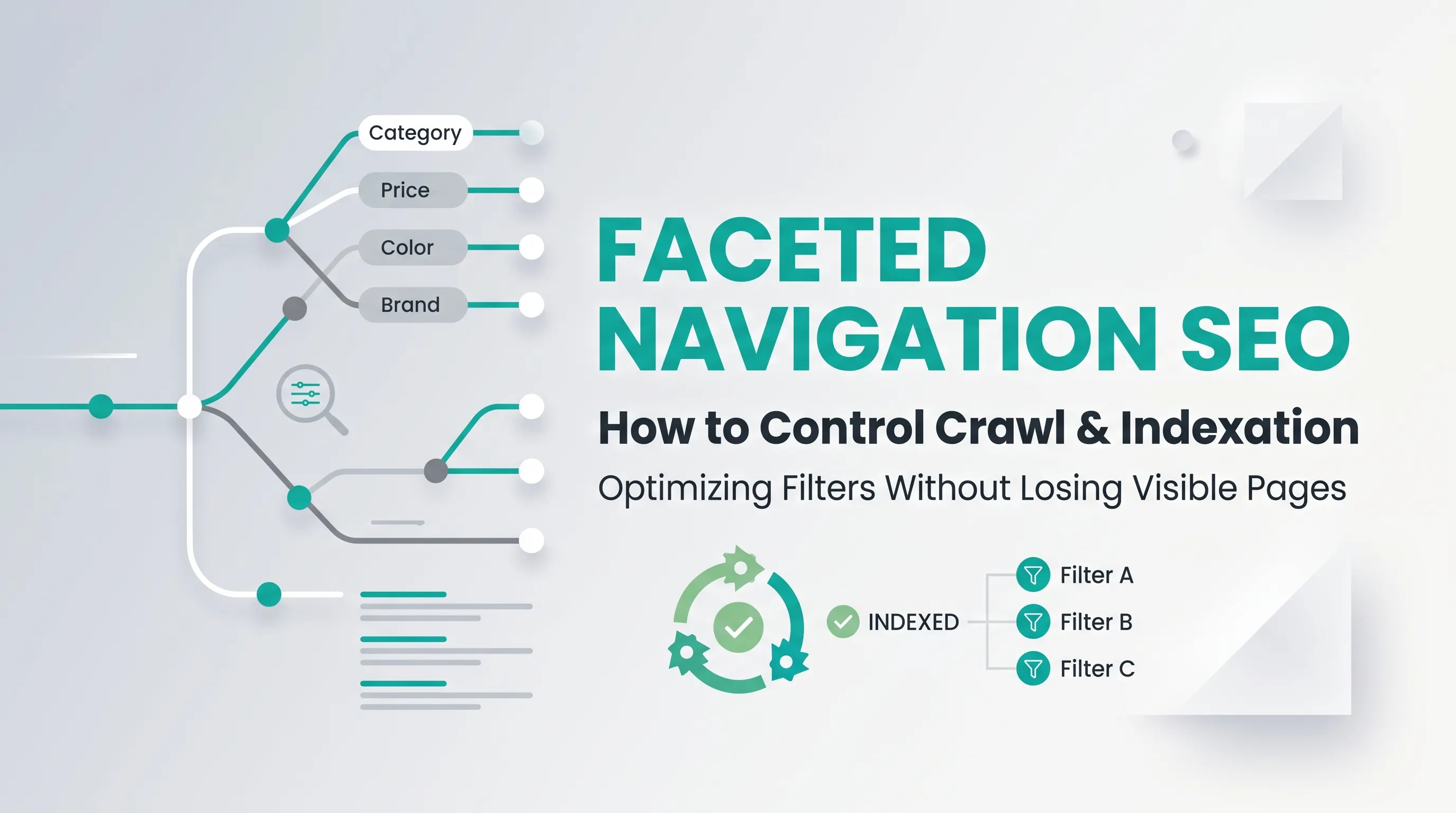
The short answer
Do not start by adding noindex or canonical to every filter URL. First classify each filter state as an indexable landing page, a crawlable duplicate, a user-only state, a noindex exception, or an invalid/empty URL. Then make URL generation, internal links, robots.txt, status codes, canonicals and sitemaps enforce that role, and verify the change in verified Googlebot logs plus Search Console.
Either prevent faceted URLs from being crawled when you do not need them indexed, or make crawlable facet URLs follow web-safe URL and response rules when they may be indexed.
Google's faceted-navigation guidance recommends returning 404 when a filter combination has no results or is otherwise nonsensical, instead of redirecting it to a generic empty listing.
When crawlable facet URLs use query parameters, Google recommends standard ampersand separation and a consistent parameter order rather than unusual separators or arbitrary permutations.
Stage 1 · Define the system
A filter interface can be small on screen and enormous in crawl space. Before changing directives, model what URLs the UI can generate and how crawlers can discover them.
Google's current faceted-navigation documentation describes the core failure mode plainly: parameterized facets can create a very large or effectively infinite URL space. Crawlers usually cannot know whether a new combination is useful until they request it, so uncontrolled facets can cause overcrawling and slow discovery of genuinely useful URLs. The first diagnostic object is therefore not a single URL; it is the URL grammar that generates the cohort.
From representative category pages, record each facet key, allowed values, multi-select behavior, sorting, pagination, tracking parameters and whether parameter order can change. Include states created only after JavaScript interaction.
PathCategory template → filter UI → generated href/history URL → server response
Pass criterionYou can enumerate the parameters and path segments that create distinct URLs and explain which UI actions generate each one.
Do not put filtering, sort order, pagination and campaign parameters into one undifferentiated bucket. They can produce similar-looking URLs but may need different crawl, indexing and canonical behavior.
Pass criterionEvery observed URL mutation has a named class and an owner: filter, sort, pagination, tracking or application state.
Multiply the available values only as a rough upper-bound exercise; then compare that theoretical space with URLs actually exposed in links, sitemaps, logs and Search Console. The calculation is diagnostic, not a traffic forecast.
Pass criterionYou have both a theoretical URL-space risk and an observed discovery/crawl sample, kept explicitly separate.
Custom diagram
The diagram separates a base category from filter dimensions and the resulting URL states, showing why eligibility decisions must happen before every combination becomes a crawlable link.
Stage 2 · Decide before directives
The durable decision is not “robots or canonical?” It is whether a URL state should exist for search at all, and what each layer must do once that role is chosen.
My recommended framework is a URL eligibility contract to keep implementation decisions consistent. It is an engineering policy, not a Google-defined taxonomy. Each state gets one intended role, and then discovery, response status, index directive, canonical signal, internal links and sitemap inclusion are checked against that role. This prevents contradictory combinations such as a URL blocked in robots.txt while the team expects Google to recrawl it and observe a noindex tag.
| State | Crawl | Index intent | Canonical / sitemap | Typical implementation | Validation |
|---|---|---|---|---|---|
| Indexable search landing page | Allowed | Eligible | Self-canonical; include canonical URL in sitemap | Stable URL, meaningful inventory, crawlable internal links | 200, indexable, self-canonical, linked, present in intended sitemap cohort |
| Crawlable duplicate/support variant | Allowed when needed | Not independently preferred | Canonical to preferred URL; omit duplicate from sitemap | Keep only when UX/technical need justifies fetchability | Declared canonical is consistent; internal links favor preferred URL |
| User-only filter state | Normally prevent broad crawl discovery | No standalone search landing-page role | Omit from sitemap | Button/form state, fragment when appropriate, or robots pattern for parameter URLs | Users can filter; unwanted URL cohort stops expanding in crawl evidence |
| Noindex exception | Allowed | Excluded from Search after Google sees directive | Do not use as a crawl-budget substitute | meta robots noindex or X-Robots-Tag noindex | Google can fetch the URL and observe noindex |
| Empty / impossible state | Fetch may occur until learned | Not a valid page | No sitemap; no canonical rescue | Return 404 at the same URL and remove links that generate it | Consistent 404; no recurring internal discovery path |
Custom diagram
A decision tree routes a filter state toward an indexable landing page, a crawlable duplicate, a user-only state, a noindex exception or a 404 based on user/search purpose and response validity.
Stage 3 · Measure observed demand
Theoretical combinations tell you where risk exists. Verified server requests tell you whether Googlebot is spending requests on those states today.
Use raw access logs when available because they let you group requests by exact URL patterns, status codes and time. Do not trust the user-agent string by itself: Google documents reverse/forward DNS checks and published IP ranges for verifying crawler requests. Search Console's Settings → Crawl stats report is useful for request trends, response breakdowns and host issues, but its example URLs are not a complete substitute for server logs.
#!/usr/bin/env python3
"""Summarize verified Googlebot requests by faceted-navigation parameter signature.

Input CSV columns:
  timestamp,url,status,user_agent,verified_googlebot

`verified_googlebot` must be produced upstream by reverse/forward DNS validation
or by matching Google's published crawler IP ranges. User-agent text alone is not
sufficient evidence that a request came from Google.
"""

from __future__ import annotations

import csv
import sys
from collections import Counter
from pathlib import Path
from urllib.parse import parse_qsl, urlsplit

FACET_KEYS = {
    "brand",
    "color",
    "size",
    "price",
    "material",
    "rating",
    "sort",
}
TRUE_VALUES = {"1", "true", "yes", "verified"}


def facet_signature(url: str) -> str:
    """Return a stable, order-independent signature for known facet keys."""
    query = parse_qsl(urlsplit(url).query, keep_blank_values=True)
    keys = sorted({key.lower() for key, _ in query if key.lower() in FACET_KEYS})
    return "+".join(keys) if keys else "no-known-facets"


def summarize(csv_path: Path) -> Counter[tuple[str, str]]:
    counts: Counter[tuple[str, str]] = Counter()
    with csv_path.open(newline="", encoding="utf-8") as handle:
        reader = csv.DictReader(handle)
        required = {"url", "status", "verified_googlebot"}
        missing = required.difference(reader.fieldnames or [])
        if missing:
            raise ValueError(f"Missing CSV columns: {', '.join(sorted(missing))}")

        for row in reader:
            if row["verified_googlebot"].strip().lower() not in TRUE_VALUES:
                continue
            signature = facet_signature(row["url"])
            status = row["status"].strip() or "unknown"
            counts[(signature, status)] += 1
    return counts


def main() -> int:
    if len(sys.argv) != 2:
        print("Usage: python facet-log-classifier.py verified-requests.csv", file=sys.stderr)
        return 2

    counts = summarize(Path(sys.argv[1]))
    print("requests\tstatus\tfacet_signature")
    for (signature, status), requests in sorted(
        counts.items(), key=lambda item: (-item[1], item[0][0], item[0][1])
    ):
        print(f"{requests}\t{status}\t{signature}")
    return 0


if __name__ == "__main__":
    raise SystemExit(main())
VERIFIED on Python 3.13.5 on 2026-09-01 against the synthetic CSV shipped with the research package. The script intentionally requires an upstream verified_googlebot flag; do not classify production traffic as Googlebot from the user-agent string alone.
For production analysis, validate source IPs using Google's documented reverse/forward DNS process or published crawler IP ranges before marking rows as verified Googlebot.
PathServer access logs → source IP → Google crawler verification
Pass criterionFacet counts are based on verified crawler requests, not on an untrusted user-agent match.
Normalize representative parameters into signatures such as brand+color, size+sort or price. Keep HTTP status alongside the signature so error and redirect patterns remain visible.
Pass criterionYou can name the highest-request facet cohorts and their dominant status codes without manually reviewing thousands of full URLs.
Compare request volume, response types and host availability around the same dates. Treat the report as high-level context; use logs for the exact facet cohort when you need URL-level completeness.
PathSearch Console → Settings → Crawl stats
Pass criterionThe log finding and Search Console trend do not materially contradict each other, or the discrepancy is documented for investigation.
Stage 4 · Promote useful states
Some filter pages deserve their own search landing-page role. The useful question is not whether a facet exists, but whether the resulting page has a durable purpose distinct from the parent category and from other filter states.
The Google guidance used for this article does not provide a numeric threshold for when a filter combination deserves indexing. That decision remains site-specific. My screening rule is to require a stable user/search task, a durable result set or inventory concept, a URL that can remain stable, and enough distinct page purpose to justify being treated as its own landing page. Search demand can support the decision, but it does not override an empty, volatile or near-duplicate experience.
Once a facet is promoted, treat it as part of your information architecture. Link to it consistently from relevant crawlable pages and avoid splitting signals across equivalent URL permutations. The same principle appears in Google's canonical guidance and is explored more deeply in Metricum Lab's internal linking architecture guide.
Stage 5 · Reduce URL discovery
If a filter state has no independent search role, preserve the UX while removing the crawlable URL expansion path. This is where robots.txt, fragments and interaction design belong.
Google's faceted-navigation guidance gives two direct approaches when filtered states do not need to be potentially indexed: disallow their crawl patterns in robots.txt, or use URL fragments for filter state because Google Search generally does not crawl/index fragment states as separate URLs. Google also notes that canonical and nofollow are generally less effective long-term crawl controls for this problem. Use fragments only for states that truly do not need independent indexing; Google's broader URL guidance says fragments should not represent separately indexable content.
# Example policy: query-string states used only for UX stay out of crawl.
# Keep indexable facet landing pages on dedicated, crawlable URLs instead.
User-agent: Googlebot
Disallow: /*?*sort=
Disallow: /*?*price=
Disallow: /*?*size=

Sitemap: https://www.example.com/sitemap.xml
STATICALLY VERIFIED against Google's current robots.txt syntax and wildcard support on 2026-09-01. This is an illustrative policy, not a rule to paste unchanged: parameter names, order and existing Allow/Disallow rules must be tested against the production URL grammar. The indexable examples in this guide use dedicated crawlable landing-page URLs rather than exceptions inside these blocked patterns.
Custom diagram
The diagram separates URL generation and discovery, crawl permission, index eligibility, canonical preference and post-release validation so one mechanism is not expected to do another layer's job.
Stage 6 · Build canonical landing pages
Once a filter state earns a search role, stop treating it as a disposable parameter variant. Give it stable discovery, response and canonical behavior.
For a facet landing page that you want available to Search, keep the URL crawlable, return a normal successful response, use a stable parameter/path convention, and make canonical signals agree. Google's canonical documentation treats redirects and rel=canonical as strong signals and sitemap inclusion as a weaker signal; it also recommends linking internally to the canonical URL rather than duplicate variants. A self-canonical is not a guarantee of Google's selection, but it removes avoidable ambiguity.
<a href> links from relevant category/navigation surfaces when it matters for discovery.Do not use canonical as a shortcut for an uncontrolled URL generator. Google notes that canonicalization can reduce crawling of non-canonical versions over time, but its faceted-navigation guidance still considers robots/fragments more effective crawl controls when those filtered URLs do not need to be crawled. The implementation should therefore reduce unwanted discovery at the source instead of relying on canonical cleanup after millions of variants exist.
Stage 7 · Close dead branches
A faceted system needs explicit failure and normalization behavior. Empty, duplicate-filter or impossible states should not stay as soft destinations, while equivalent parameter-order URLs should converge on one identity.
Google's faceted-navigation guidance specifically recommends a 404 response when a filter combination returns no results or is otherwise nonsensical, and says not to redirect such URLs to a generic empty listing. This lets crawlers learn that the state is not a valid resource. The engineering work is to make this response deterministic across server rendering, API failures and client-side transitions.
| Observed state | Preferred behavior | Why | Verification |
|---|---|---|---|
| Valid combination with useful inventory | 200 + intended eligibility policy | It is a real user destination | Status, canonical, robots meta, product set and links match contract |
| Zero-result combination | 404 | No valid resource exists at this state | HTTP response remains 404 in SSR/direct request and is not converted to 200 by the app shell |
| Impossible or unknown facet value | 404 | Prevents arbitrary parameter values from becoming valid crawl branches | Random invalid values consistently return 404 |
| Same state in different parameter order | Normalize to one URL or consolidate duplicates | Avoids multiple identities for one result set | Crawler/log sample shows one preferred order/URL |
| Sort-only variant | Normally user-only / non-indexable policy | Ordering changes often do not create a distinct landing-page purpose | Not in sitemap; crawl/index behavior matches contract |
Stage 8 · Preserve product discovery
It is possible to stop facet URL explosion and accidentally make products harder to discover. Crawl control and core catalog discovery must be validated separately.
Google's ecommerce guidance recommends making products reachable through site navigation and notes that Googlebot generally does not submit searches into a site's search box. Its link guidance says normal crawlable links are usually <a href> elements; event-only pseudo-links are not a reliable replacement. Therefore a non-indexable filter UI can use buttons/forms/fragments for state, while the underlying category → subcategory → product graph still needs crawlable paths or another deliberate discovery mechanism such as a sitemap.
Start from the same seed URLs a search crawler can discover and verify that important categories, subcategories and products remain reachable through crawlable links or are deliberately represented in a sitemap.
Pass criterionCritical product/detail URLs are still discoverable without requiring a crawler to click filter buttons or submit an internal search form.
For promoted landing pages, test a fresh direct request and rendered output. If client-side routing changes the URL, make sure the server/SSR path resolves the same intended resource instead of depending on a prior UI state.
Pass criterionA promoted facet URL is independently loadable and returns the same intended content/metadata when requested directly.
Inspect rendered anchors and URL changes after using non-indexable filters. The UX can remain interactive, but it should not emit thousands of new crawlable links for states the eligibility contract excludes.
Pass criterionUser-only filters work for people while the rendered link graph exposes only the URLs intended for crawl discovery.
If filters are JavaScript-driven, validate the rendered DOM and direct-route behavior rather than assuming the framework will make the right crawl/index decision. Metricum Lab's JavaScript SEO debugging guide covers the separate crawl → server response → render → index evidence chain for client-rendered applications.
Stage 9 · Verify the same cohorts
A successful rollout should reduce unwanted facet crawling without sacrificing discovery and indexability of the filter pages you intentionally kept.
Do not declare success because a crawler now reports fewer URLs. Compare the same parameter signatures and landing-page cohorts before and after release. Google also cautions that freeing crawl capacity does not guarantee that the saved requests will be reallocated to other URLs unless the site was already constrained by its crawl capacity limit. The defensible outcome is therefore less unwanted crawling plus healthy intended URLs, not a promised percentage increase in crawling elsewhere.
Use the same signatures, verified crawler criteria and comparable date windows as the baseline. Check request counts, status-code mix and newly appearing parameter patterns.
Pass criterionUnwanted facet cohorts stop expanding or materially decline, while valid landing-page and product crawling remains observable.
Review crawl requests, response breakdowns and host availability around deployment. A crawl-control release should not coincide with a new serving problem that explains the change instead.
PathSearch Console → Settings → Crawl stats
Pass criterionThe crawl change is not explained by host errors, availability degradation or another unrelated site-wide event.
Test indexable landing pages, crawlable duplicate variants, user-only states, noindex exceptions and invalid/empty combinations separately. Verify status, robots access, meta robots, canonical, links and sitemap membership against the contract.
Pass criterionEvery sampled URL behaves according to its assigned state; contradictory signals are treated as defects, not exceptions.
Use Search Console to monitor representative landing-page cohorts and investigate unexpected canonical/index states. A single URL can lag or change for unrelated reasons, so preserve cohort-level evidence and the release date.
Pass criterionImportant landing-page cohorts remain eligible/discoverable and there is no new systematic indexation regression after crawl controls ship.
Stage 10 · Make the policy durable
Facet systems change with catalog attributes, merchandising, frontend rewrites and localization. The control policy has to ship with those changes.
The practical principle is simple: control the URL inventory before you try to clean up crawler behavior after the fact. Start by mapping one representative category and writing the eligibility contract for its filter states. The critical limitation is that no generic rule can decide which facets deserve organic landing pages for every business; that requires real inventory, query and conversion context. Once the role is chosen, however, the implementation is testable: URL generation, crawl permissions, status codes, canonical signals, internal links and sitemap membership can all be validated against the same contract.
If Search Console later reports valuable facet pages as Crawled — currently not indexed, diagnose that as a separate index-selection problem after first proving that the faceted-navigation policy is behaving as designed. Crawl control narrows the URL space; it does not guarantee index selection.
Primary sources and documentation
Every changing search, browser, interface or technical-behavior claim in this guide is tied to a current primary source.
Need help diagnosing and implementing the fix?
Metricum Lab can map faceted URL generation, verify crawler demand, define indexable landing-page cohorts and translate the policy into engineering rules with before/after validation.
Explore Crawl & Indexation services